
Ciencia Astronómica
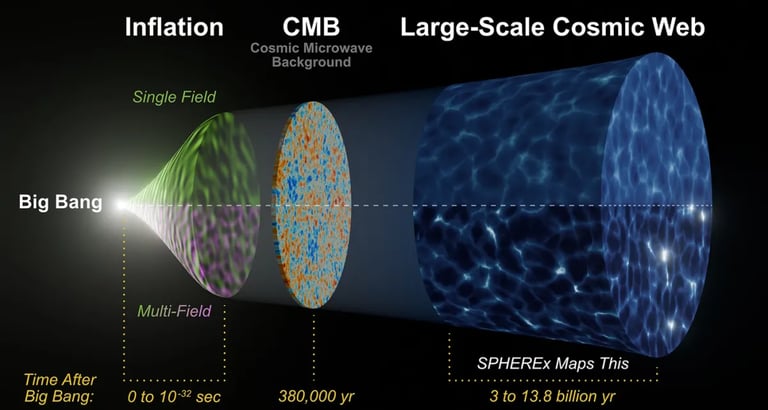
In the aftermath of inflation, signatures are imprinted onto the Universe that are unmistakably inflationary in origin. While the CMB provides an early-time “snapshot” of these features, that’s just one moment in history. By probing the large variety of times/distances accessible to us throughout cosmic time, such as with large-scale structure, we can obtain information that would otherwise be obscure from any single snapshot: an array of snapshots from all different cosmic epochs. Credit: Caltech/Robert Hurt(IPAC)


Through the vacuum of space, all light, regardless of wavelength or energy, travels at the same speed: the speed of light in a vacuum. When we observe light from a distant star, we are observing light that has already completed that journey from the source to the observer. Credit: Lucas Vieira/Wikimedia Commons
Big Think, Starts With A Bang
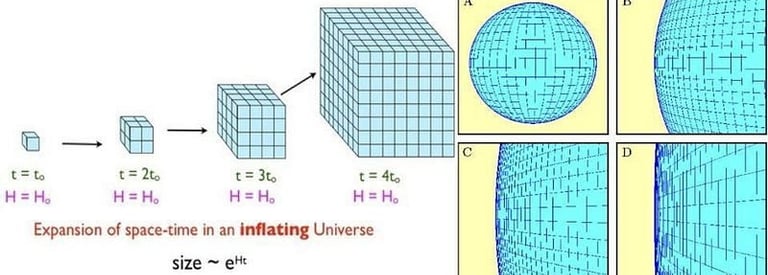
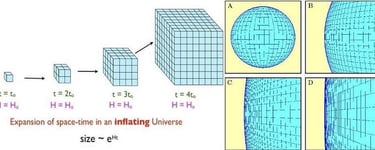
Inflation causes space to expand exponentially, which can very quickly result in any pre-existing curved or non-smooth space appearing flat. If the Universe has any curvature to it at all, it has a radius of curvature hundreds of times larger than what we can observe. (E. Siegel (L); Ned Wright’s cosmology tutorial (R))


Trajectories of a particle in a box (also called an infinite square well) in classical mechanics (A) and quantum mechanics (B-F). In (A), the particle moves at constant velocity, bouncing back and forth. In (B-F), wavefunction solutions to the Time-Dependent Schrodinger Equation are shown for the same geometry and potential. The horizontal axis is position, the vertical axis is the real part (blue) or imaginary part (red) of the wavefunction. These stationary (B, C, D) and non-stationary (E, F) states only yield probabilities for the particle, rather than definitive answers for where it will be at a particular time. Credit: Steve Byrnes via Mathematica; Sbyrnes321/Wikimedia Commons
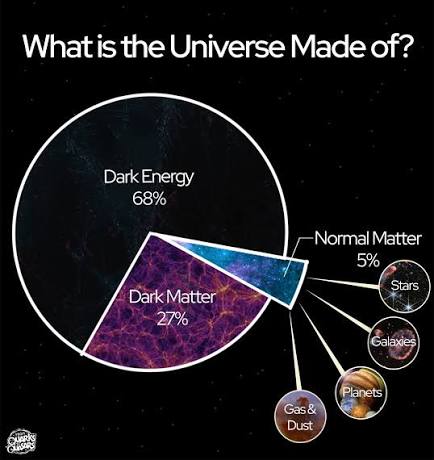
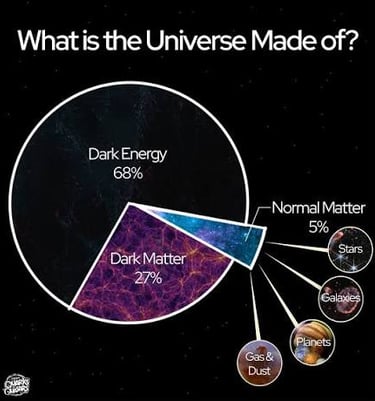
The universe consists of three main components: dark energy (68.3%), dark matter (26.8%), and ordinary matter (4.9%).
Dark Energy
Percentage: approx 68.3% of the universe.
What is known: It acts as a mysterious force causing the expansion of the universe to speed up instead of slowing down. It behaves like an intrinsic property or pressure of space itself ("anti-gravity"), but its exact physical identity remains completely unknown.
Dark Matter
Percentage: approx 26.8% of the universe.
What is known: It does not emit, absorb, or reflect light. Scientists know it exists because its gravity holds fast-spinning galaxies and galaxy clusters together. It is believed to be made of an undiscovered subatomic particle that interacts very weakly with ordinary matter.
Ordinary (Baryonic, Normal) Matter
Percentage: approx 4.9% of the universe.
What is known: This includes all atoms, elements, stars, planets, and gas. Of this tiny fraction, free-floating hydrogen and helium gas make up about (4%), stars make up about (0.5%), neutrinos make up (0.3%), and heavy elements (like carbon, oxygen, and iron that make up rocky planets and life) comprise a mere (0.03%).
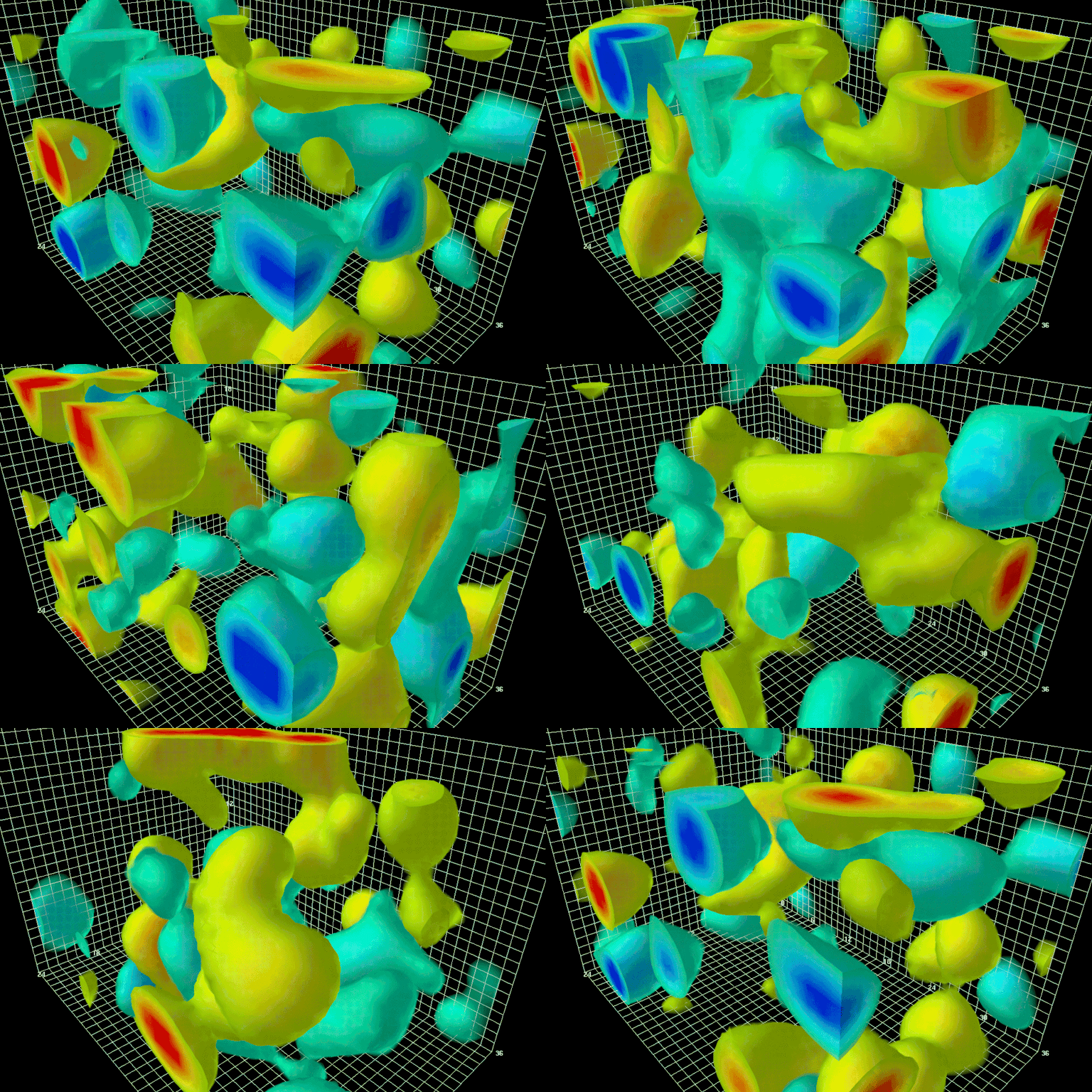
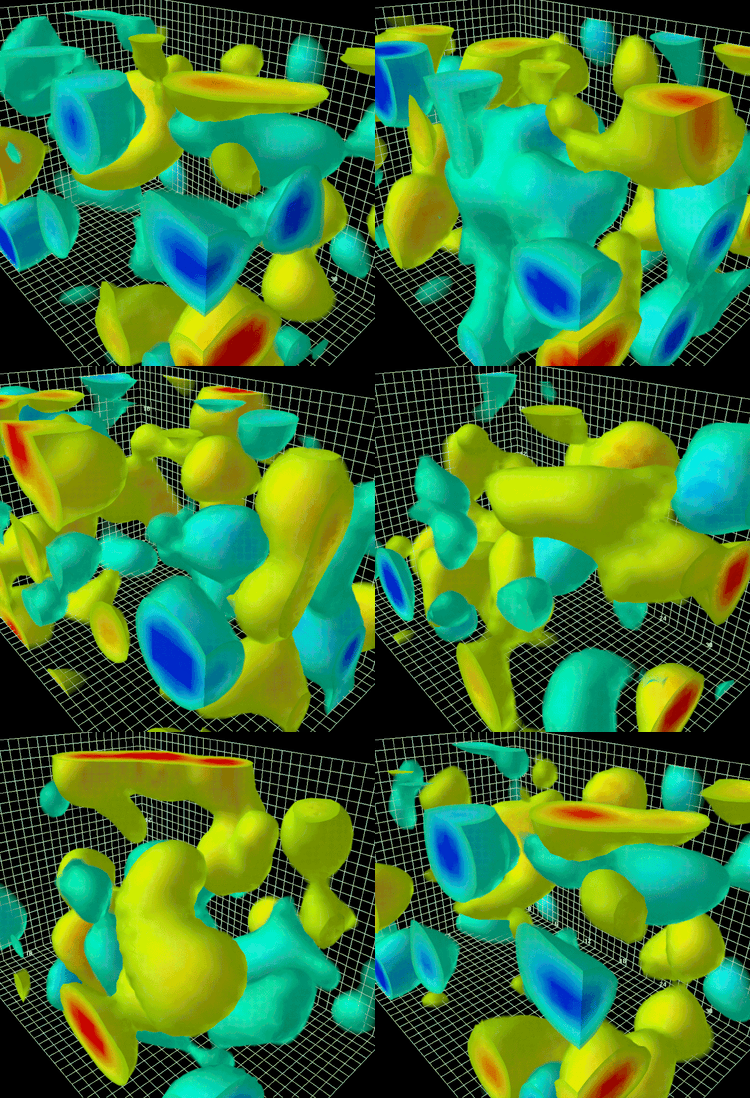
Visualization of a quantum field theory calculation showing virtual particles in the quantum vacuum. (Specifically, for the strong interactions.) Even in empty space, this vacuum energy is non-zero. If there are additional particles or fields beyond what the Standard Model predicts, they will affect the quantum vacuum and will change the properties of many quantities away from their Standard Model predictions. However, the QCD contribution cannot be calculated perturbatively, the way electromagnetism can. Credit: Derek Leinweber
Medium - Ethan Siegel
The Universe Requires Quantum Fields
Are Quantum Fields Real?
Proof That Quantum Fields Carry Energy
Do Virtual Particles Really Exist?
Virtual Particles Can Have Real, Observable Effects
LRDs, Most Overlooked Fact
LRDs, Mystery Solved?
Did Black Holes Exist Before Galaxies?
Why Isn't the Universe Perfectly Smooth?
How Quantum Physics Creates the Largest Structures
Prof. Matt Strassler
Contacto
Por favor envíe un correo electrónico para solicitar más información.
Email: info@observatoriosanjavier.com
© 2025. All rights reserved.
Observatorio de San Javier, BCS, México